
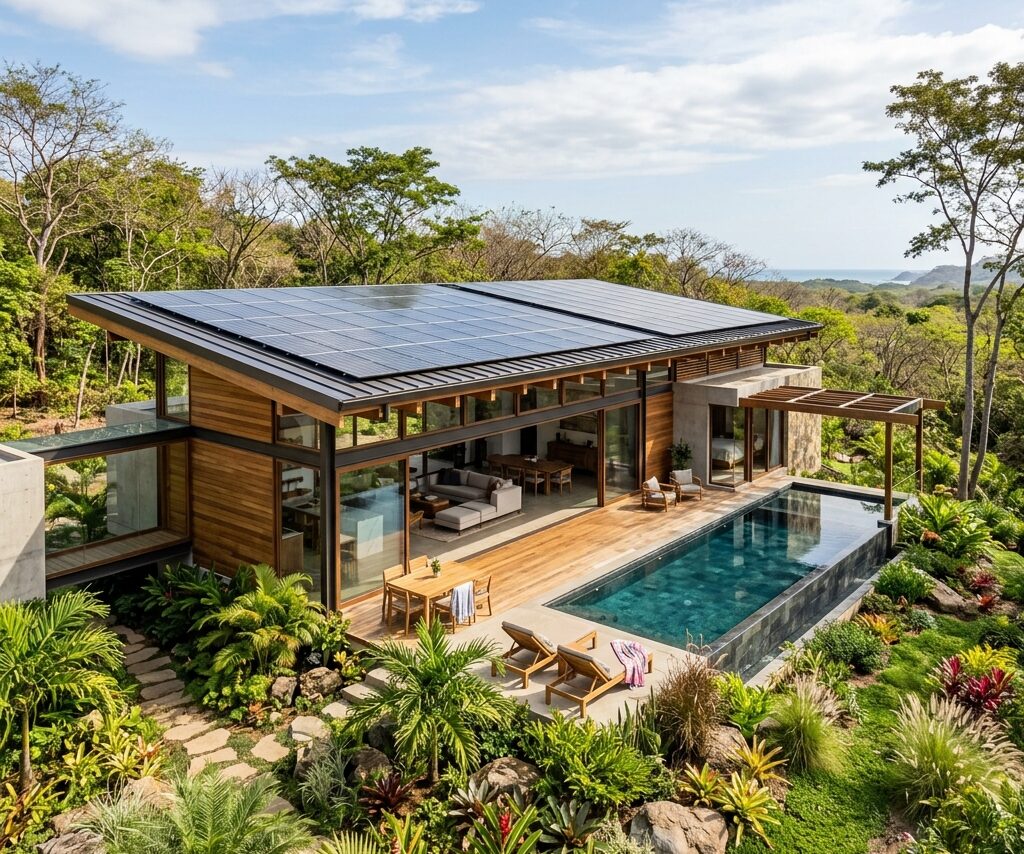

Guanacaste is famous for its perfect weather, but that “perfect” weather means 95-degree heat and intense sun for six months straight.
If you are operating a luxury vacation rental, keeping a 4,000-square-foot villa cooled to 72 degrees requires running industrial-grade air conditioning 24/7. In Costa Rica, where electricity rates are significantly higher than in the United States, your monthly power bill can easily exceed $1,500 to $2,000.
This single line item destroys capitalization rates.
The solution, which is rapidly becoming the gold standard for savvy investors, is the net-zero home. Buying sustainable homes in Guanacaste is no longer just an environmental statement; it is a ruthless financial strategy designed to maximize net ROI.
The Reality Check: A true net-zero home generates as much energy as it consumes over the course of a year. In Guanacaste, this requires commercial-grade solar arrays, high-capacity lithium battery banks, and passive cooling architecture. While these systems add 10% to 15% to the initial construction cost, they eliminate your largest operational expense and dramatically increase the resale value of the property.
The Financial Mechanics of Going Net-Zero
Let’s look at the math that makes eco-friendly villas so attractive.
If your standard luxury rental in Tamarindo grosses $150,000 a year, but your electricity bill averages $18,000 annually, you are bleeding 12% of your gross revenue just to keep the lights on.
A net-zero home utilizes bidirectional metering with ICE (the national electric company). During the day, your solar panels generate massive excess energy, which spins your meter backward and credits your account. At night, you run off the grid (or your battery banks) using those credits.
By eliminating that $18,000 annual expense, you immediately add $18,000 to your Net Operating Income (NOI). At a 6% Cap Rate, that $18,000 in savings adds $300,000 of intrinsic value to the property.
The Architectural Shift: Passive Cooling
You cannot achieve net-zero status just by slapping solar panels on a poorly designed house. The architecture itself must do the heavy lifting.
The best new developments in Guanacaste are returning to traditional tropical design principles, modernized for the luxury market. This includes:
* Deep Overhangs: Preventing direct sunlight from hitting the glass walls, drastically reducing the internal thermal load.
* Cross-Ventilation: Designing homes that naturally channel the Papagayo trade winds through the living spaces.
* Green Roofs and High-R Insulation: Creating thermal breaks so the heavy tropical sun doesn’t bake the interior.
The Demographic Premium
The luxury renter demographic coming to Costa Rica is highly conscious of sustainability.
Tech executives from California and professionals from Europe specifically filter their Airbnb and VRBO searches for eco-friendly properties. They will happily pay a 15% premium on the nightly rate to stay in a home that operates entirely off solar power and utilizes advanced water recycling systems.
You win on the expense side, and you win on the revenue side.
The Bottom Line
Net-zero homes are the future of the Guanacaste real estate market. The upfront premium pays for itself rapidly through operational savings and higher rental yields.
If you want to acquire an asset that insulates you from rising energy costs and commands top-tier rental rates, let’s talk.
📩 josh@kraincostarica.com
Frequently Asked Questions
Are solar panels worth it in Costa Rica?
Absolutely. Given the high cost of electricity in Costa Rica and the abundance of year-round sunlight in regions like Guanacaste, solar panels offer an incredible return on investment, often paying for themselves in 4 to 6 years.
What is a net-zero home?
A net-zero home is designed to produce as much renewable energy (typically via solar panels) as it consumes over a year, resulting in a net-zero energy bill.
Is sustainable real estate more expensive to buy?
The initial acquisition or construction cost of a net-zero home is typically 10% to 15% higher than a traditional build due to the cost of solar arrays and high-efficiency materials, but the operational savings drastically improve the long-term ROI.

Leave a Reply