
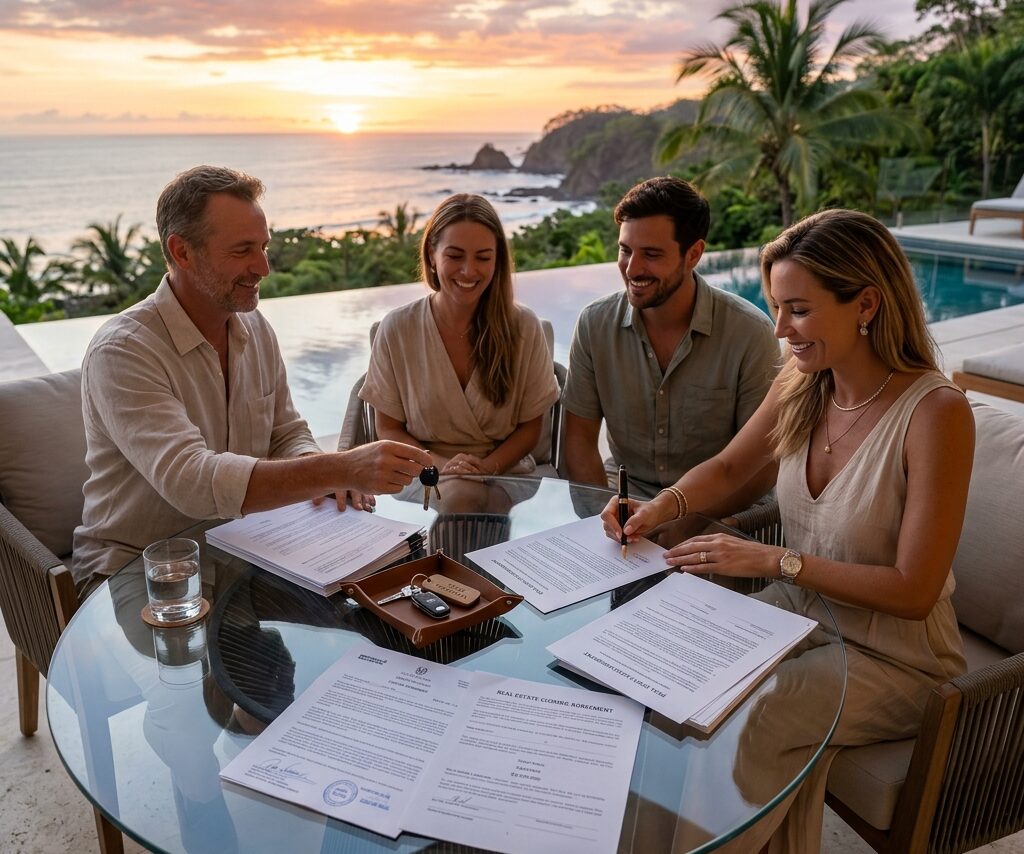

I see it happen to expats all the time. They find the perfect investment property, negotiate hard on the purchase price, and calculate a brilliant 10% ROI. But they completely forget to factor in the cash required at the closing table. Two days before they sign the deed, they get a settlement statement showing an extra $25,000 in fees, and their cash-flow projections are instantly thrown out the window.
If you are buying property in Costa Rica, you have to know that closing costs here are generally higher than what you might be used to in the United States or Canada.
To model a safe, accurate pro-forma, you need to expect to pay roughly 4% to 5% of the purchase price in closing costs. But the difference between 4% and 5%—and whether you can legally reduce that number—comes down to how you structure the deal and the quality of your real estate attorney.
The Reality Check: Closing costs in Costa Rica typically range between 4% and 5% of the declared purchase price. This total is comprised of the government Property Transfer Tax (1.5%), National Registry stamps and fees (approx. 0.85%), the Notary Public’s legal fees (1% to 1.25%), and third-party escrow fees. By tradition, the buyer and seller split these costs 50/50, but in today’s market, everything is negotiable.
The Standard 4% to 5% Breakdown
When you buy a home in Guanacaste, you are not just paying your agent and a title company. You are paying a combination of government taxes, registry stamps, and specialized legal professionals.
Here is the exact breakdown of what makes up that 4% to 5% figure:
- Property Transfer Tax: 1.5% of the registered value or the purchase price (whichever is higher).
- National Registry Stamps: Approximately 0.85% (this includes agrarian, municipal, and fiscal stamps required to record the deed).
- Notary Public Legal Fees: Regulated by the Costa Rican Bar Association, typically set at 1% to 1.25% of the purchase price.
- Escrow Fees: SUGEF-regulated escrow companies usually charge a flat fee or a small percentage (ranging from $500 to $1,500 depending on the transaction size).
The Property Transfer Tax (And How to Legally Avoid It)
The largest chunk of your closing costs is the 1.5% Transfer tax. However, there is a legal, widely used strategy to bypass this specific tax, provided the seller has structured their property correctly.
If the seller holds the property inside a Costa Rican corporation (an S.A. or LLC), you do not have to buy the physical real estate. Instead, you buy 100% of the shares of that corporation through a Share Transfer Agreement.
Because the physical real estate never actually changes hands—it remains owned by the same corporation—the 1.5% Property Transfer Tax is not triggered. You still pay legal fees for the share transfer, but on a $1,000,000 property, avoiding the transfer tax instantly saves $15,000 at the closing table.
Note: You must have your attorney conduct aggressive due diligence on the corporation to ensure it holds no hidden debts or liabilities before buying the shares.
Notary Fees vs. Escrow Fees
Many expats confuse the role of the Notary Public with the Escrow Company. You must pay for both, and they serve entirely different functions.
- The Notary Public: In Costa Rica, a Notary is a specialized attorney who drafts the actual public deed (Escritura Pública) and is legally responsible for recording it in the National Registry. You are paying them for legal execution and title research.
- The Escrow Company: The Notary cannot legally hold your funds. You pay an independent, SUGEF-regulated escrow company to handle the Anti-Money Laundering (AML) checks and disburse the funds securely at closing.
Who Actually Pays at the Closing Table?
Unlike in the U.S. where buyer and seller have rigidly defined columns of expenses, Costa Rica operates heavily on negotiation.
Traditionally, the unwritten rule is a 50/50 split of the transfer tax, stamps, and legal fees. However, in a strong seller’s market, it is increasingly common for the seller to demand the buyer cover 100% of the closing costs. Conversely, if you are buying a pre-construction developer unit, the developer will almost always stipulate that the buyer pays the closing costs in full.
The Bottom Line
You cannot build a true ROI model without accounting for every dollar spent before you even get the keys. Whether you are paying 4% or splitting the costs 50/50, closing costs are a hard reality of investing in Costa Rica.
Need a precise pro-forma before you make an offer? I run the real numbers for my clients every day, including exactly what they will need at the closing table. Let’s talk.
📩 josh@kraincostarica.com
Frequently Asked Questions
What are the average closing costs in Costa Rica?
Closing costs in Costa Rica average between 4% and 5% of the final purchase price. This includes the 1.5% property transfer tax, National Registry stamps (0.85%), and the Notary Public’s legal fees (1% to 1.25%).
Who pays the closing costs in Costa Rica?
Traditionally, closing costs are split 50/50 between the buyer and the seller. However, this is not a law; it is a negotiation. Depending on the market conditions and the specific contract, a buyer may end up paying 100% of the closing costs.
Do you pay property taxes at closing in Costa Rica?
Yes. To legally transfer the title, the seller must provide a certification proving that municipal property taxes and the Luxury Home Tax (if applicable) are paid in full through the current quarter or year of the closing date.

Leave a Reply