
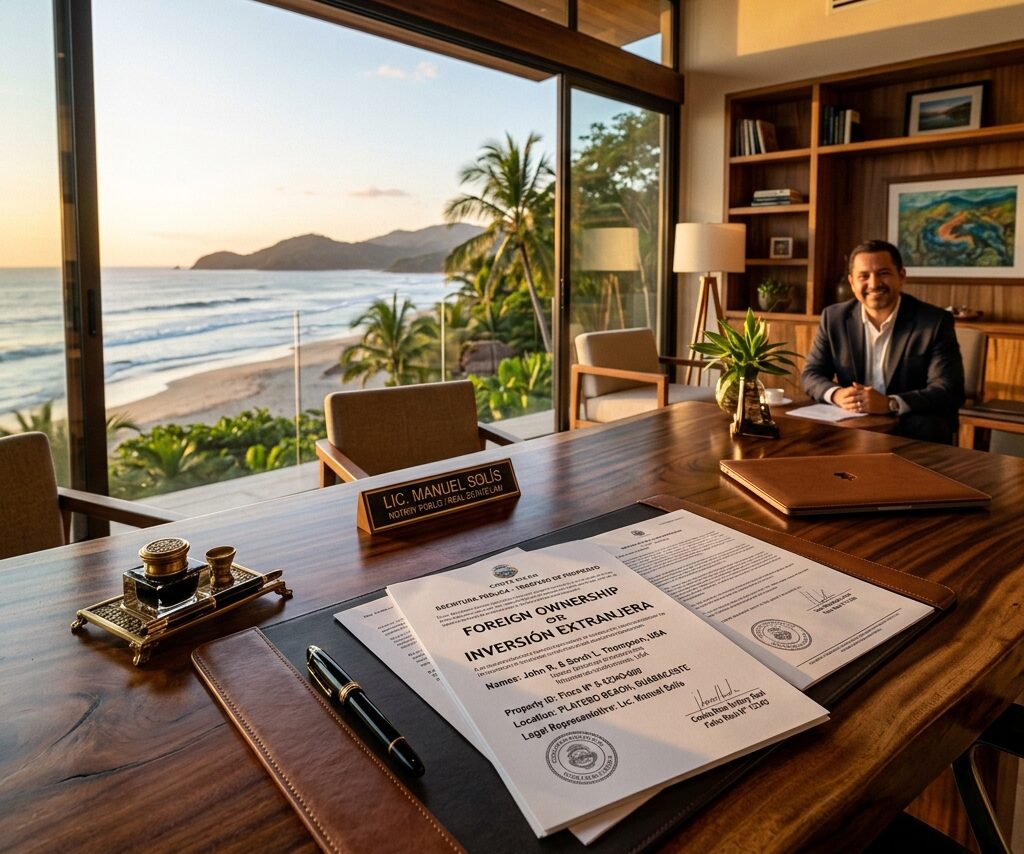

I was sitting with a couple from Seattle last month who were ready to wire funds for a spectacular oceanfront lot in Playa Grande. They had the cash, the vision, and the architectural plans drawn up. But when we sat down with my attorney to review the title, they almost walked away. They learned that because the property was a maritime concession, they couldn’t simply put both of their names on the deed like they would back in Washington state.
As an American buying beach property, assuming you can own the sand under your feet exactly as you do in the US is the fastest way to derail a transaction. Yes, you absolutely can own beachfront property here, but how you structure that ownership dictates everything.
If you’re looking at ocean view lots or beachfront estates, you need to understand that maritime law in Costa Rica plays by a different set of rules, and ignorance of those rules can jeopardize your asset.
The Reality Check: While foreigners have the same rights as locals for standard inland real estate, beachfront property falls under the Maritime Zone Law. 95% of beachfront land is held as a government lease (a Concession). By law, a foreigner who has not been a resident for at least five years cannot own more than 49% of a concession property in their personal name. To legally control the asset, foreign buyers must use specific corporate structures—like a Costa Rican S.A. managed by a trust—to satisfy the 51% local ownership requirement while maintaining total financial control.
The Short Answer: Yes, But With Conditions
Can a US citizen own beachfront property in Costa Rica? The answer is a heavily qualified yes.
The Costa Rican government is highly protective of its coastline. Unlike Mexico, where you use a bank trust (fideicomiso) to buy near the coast, Costa Rica divides its beaches into the Maritime Terrestrial Zone. The first 50 meters from the high-tide line are public. The next 150 meters are the Restricted Zone, where you don’t buy the land; you buy a concession (a long-term lease) to use the land.
While residency by investment is an option for many expats, unless you already have five years of legal residency under your belt, the government will not grant you 100% control of a concession in your own name.
The 49/51 Rule for Maritime Concessions
This is where many foreign buyers panic: The 49/51 rule. By law, 51% of a concession must be owned by a Costa Rican citizen or a wholly Costa Rican entity.
When buyers hear this, the friction is immediate. They tell me, “Josh, I am not handing over 51% of my multi-million-dollar investment to a local partner I just met.”
And you absolutely shouldn’t. The 49/51 rule is a legal hurdle, but it is one that top-tier attorneys in Guanacaste navigate every single day. You do not go out and find a local business partner to hold your asset; you build a corporate shield.
Legal Structures: Trusts and S.A. Corporations
To safely acquire a concession property, we rely on robust corporate structuring. The upfront legal costs are higher than buying a standard inland home, but unlocking the ROI of premium beachfront inventory makes it a necessary business expense.
Here is how smart money structures a beachfront acquisition:
* The S.A. Corporation: You form a Costa Rican Sociedad Anónima (S.A.) to hold the concession.
* The 49% Shares: You (the foreign buyer) own 49% of the shares directly.
* The 51% Shares in Trust: The remaining 51% of the shares are placed into a legally binding Guaranty Trust (Fideicomiso), administered by a highly reputable, SUGEF-regulated Costa Rican trust company or bank.
* Absolute Control: The trust dictates that the 51% shares can only vote, act, or be sold under your direct, written instruction.
This structure perfectly satisfies the government’s requirement for local entity ownership while ensuring you retain 100% financial and operational control of your asset.
Finding “Titled” Beachfront (And Why It’s Expensive)
If the trust structure sounds too complex, there is an alternative: Fee-Simple (Titled) Beachfront.
Roughly 5% of Costa Rica’s coastline was legally titled before the 1977 Maritime Zone Law was enacted. In areas like Tamarindo, Langosta, and Flamingo, you can occasionally find these grandfathered properties. Because they are fee-simple, foreigners can own them 100% in their own names with zero restrictions.
However, because this inventory is mathematically finite and avoids the bureaucracy of concessions, titled beachfront commands an astronomical price premium. You are paying heavily for the simplicity.
The Bottom Line
You can own beachfront property in Costa Rica, but you cannot do it with a handshake and a generic contract. Securing a concession requires methodical, aggressive legal structuring to ensure your capital is protected from the 51% rule.
Don’t navigate maritime law alone. If you’re serious about beachfront inventory in Guanacaste and need to know your capital is safe, let’s talk.
📩 josh@kraincostarica.com
Frequently Asked Questions
Can a US citizen own beachfront property in Costa Rica?
Yes, but most beachfront property is leasehold (concession) land. A non-resident foreigner can only own 49% of a concession directly. To control the property safely, foreigners must use a corporate structure and a trust to hold the remaining 51%.
What is the 51 percent rule in Costa Rica real estate?
The 51% rule applies exclusively to maritime zone concession properties. It mandates that at least 51% of the concession must be held by a Costa Rican citizen, a Costa Rican entity, or a resident of over five years. It does not apply to standard, inland titled real estate.
How do foreigners safely buy concession land in Costa Rica?
Foreigners safely acquire concession land by forming a Costa Rican corporation (S.A.) where they hold 49% of the shares, and placing the remaining 51% of the shares into a legally binding Guaranty Trust managed by a registered Costa Rican attorney or bank, giving the foreigner complete operational control.
Leave a Reply