
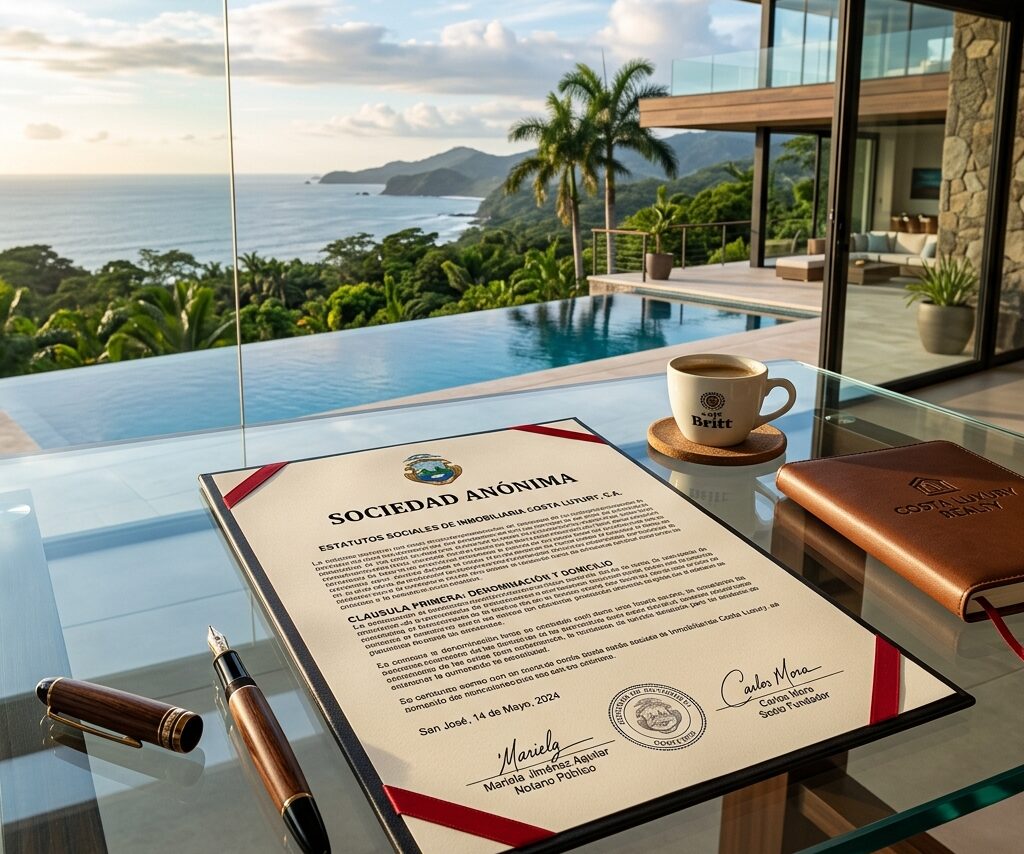

Whenever a new client tells me they are ready to write an offer on a home in Guanacaste, one of my first questions is, “Do you have your Costa Rican corporation set up yet?”
Nine times out of ten, they look at me blankly. They assume they will just put the deed in their own name, or maybe under the name of their existing LLC back in Texas or California.
I immediately stop them. While you can legally buy property in Costa Rica in your personal name, doing so is a massive, easily avoidable mistake. It exposes you to unnecessary liability, complicates estate planning, and makes your eventual exit strategy far more expensive. If you are serious about asset protection, the only way to structure your Costa Rica investment is through a local corporate entity.
The Reality Check: You should almost never buy Costa Rican real estate in your personal name. The gold standard for foreign investors is to purchase the property through a newly formed Costa Rican corporation—either a Sociedad Anónima (S.A.) or a Sociedad de Responsabilidad Limitada (S.R.L.). Doing so isolates your liability, simplifies the probate process in the event of death, and allows you to avoid the 1.5% property transfer tax when you eventually sell the asset by transferring the corporate shares instead of the physical real estate.
Why Personal Ownership is a Rookie Mistake
When you buy a vacation rental in your personal name, your personal assets are suddenly tied to whatever happens on that property. If a renter slips by the pool and decides to sue, your personal name is on the lawsuit.
By placing the property inside a Costa Rica LLC or S.A., you create an immediate corporate shield. The only asset that corporation holds is the house itself. It legally isolates your investment from your personal finances back home.
Furthermore, if you own the property personally and pass away, the property must go through the Costa Rican probate process, which is notoriously slow, bureaucratic, and expensive. If the property is held in an S.A., you can simply issue shares to your heirs, bypassing the probate courts entirely.
The Two Options: S.A. (Sociedad Anónima) vs. S.R.L.
When setting up your corporate shield, you generally have two choices. Both cost roughly $700 to $1,200 to establish through a reputable attorney.
- Sociedad Anónima (S.A.): Similar to a C-Corp. It requires a board of directors (President, Secretary, Treasurer) and a Fiscal (Controller). This is the most common structure, but it requires finding three trusted people to fill the board roles (they do not need to own shares, just hold the titles).
- Sociedad de Responsabilidad Limitada (S.R.L.): Similar to a US LLC. It only requires one Manager (Gerente) and is much simpler to administer. This is becoming the preferred choice for single investors or married couples.
The ROI of Corporate Structures: Saving on Transfer Taxes
The biggest financial benefit of using a corporate structure comes when it is time to sell.
If you own the property personally, you have to sell the physical real estate. This triggers the government’s 1.5% Property Transfer Tax, which the buyer has to pay.
If you own the property through an S.A., you do not sell the real estate. Instead, you sell 100% of the shares of the S.A. to the new buyer. Because the property itself never changed hands (the corporation still owns it), the 1.5% transfer tax is not triggered. In a competitive market, being able to offer a buyer a “share transfer” saves them thousands of dollars in closing costs, making your property far more attractive.
Additionally, isolating the property in a corporation makes calculating your Capital gains tax much cleaner, as the corporation’s sole financial history is tied directly to that single asset.
The Catch: Annual Corporate Obligations
Is a corporation a magic bullet? No. It requires annual maintenance.
Once you open an S.A. or S.R.L., you are legally required to:
* Pay an Annual Corporate Tax (Impuesto a las Personas Jurídicas), which is roughly $120 to $400 depending on whether the corporation is active or inactive.
* File the annual Registry of Transparency and Final Beneficiaries (RTBF) in April, declaring who actually owns the shares.
* File an annual income tax declaration (even if the corporation is “inactive” and generates zero income).
The Bottom Line
The upfront cost of forming an S.A. or S.R.L. is negligible compared to the legal protection and tax savings it provides on the back end. It is the absolute baseline requirement for any serious investor operating in this market.
If you’re ready to invest and want to ensure your asset is legally isolated from day one, let’s talk. My legal team sets these up every week, and we make sure it is done right.
📩 josh@kraincostarica.com
Frequently Asked Questions
Should I buy property in Costa Rica through an S.A. or LLC?
Yes. Purchasing real estate through a Costa Rican Sociedad Anónima (S.A.) or Sociedad de Responsabilidad Limitada (S.R.L.) protects your personal assets from liability, simplifies the inheritance process, and offers significant tax advantages when you eventually sell the property.
What is a Sociedad Anónima in Costa Rica?
A Sociedad Anónima (S.A.) is a Costa Rican corporate structure similar to a US corporation. It issues shares and requires a board of directors (President, Secretary, Treasurer). It is widely used by foreign investors to hold real estate and isolate liability.
How much does it cost to set up an S.A. in Costa Rica?
Setting up a new S.A. or S.R.L. through a reputable Costa Rican Notary Public typically costs between $700 and $1,200 USD. This fee includes drafting the articles of incorporation, registering the company in the National Registry, and issuing the corporate books and shares.

Leave a Reply