
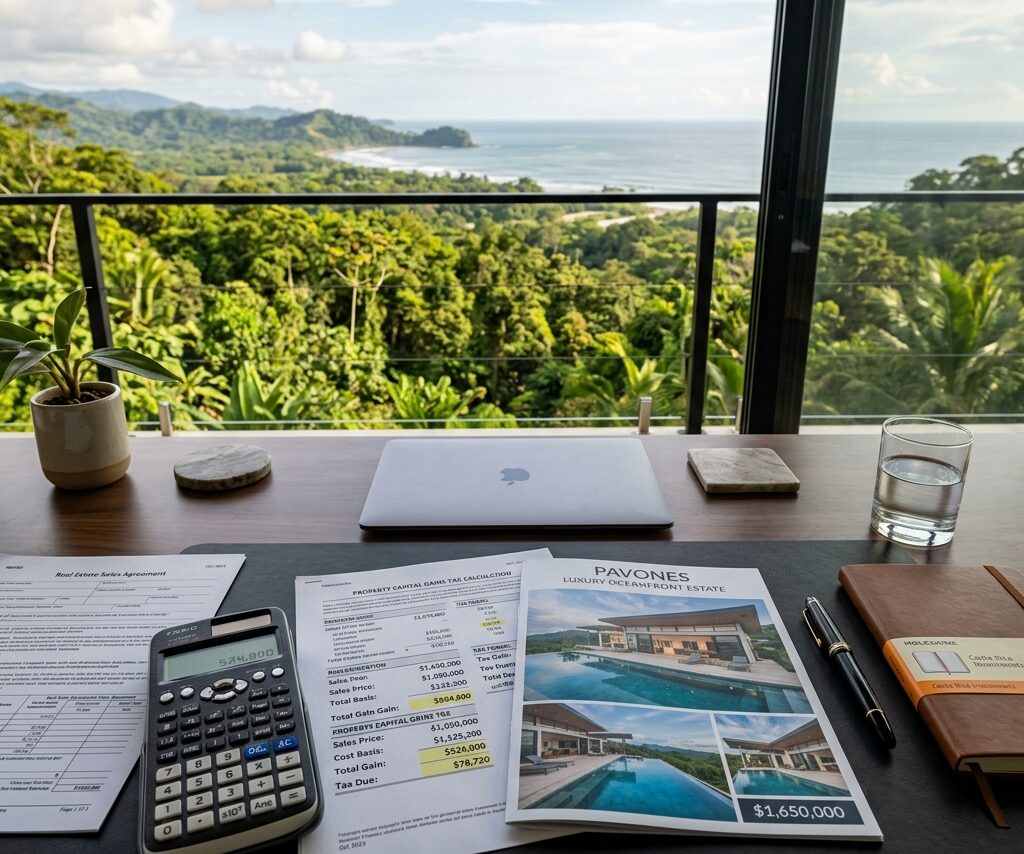

For decades, Costa Rica was considered an absolute tax haven for real estate investors. You could buy a piece of Guanacaste real estate for $200,000, sell it five years later for $500,000, and pay exactly zero dollars in capital gains tax to the Costa Rican government.
That all changed on July 1, 2019, when a sweeping tax reform was implemented.
I still meet sellers who bought their properties in 2015 and have no idea the law changed. When I sit down to do their net-sheet before listing their home, the realization that they owe 15% on their equity gain is a tough pill to swallow. However, selling property in Costa Rica doesn’t mean you have to hand over all your profit. If you understand the exemptions and the alternative calculation methods, you can legally protect tens of thousands of dollars.
The Reality Check: Since July 2019, Costa Rica levies a flat 15% Capital Gains Tax on the profit (sale price minus registered cost basis) of real estate transactions. However, there are two massive exemptions: 1) If the property is proven to be your primary residence, the sale is 100% exempt from capital gains tax. 2) If you acquired the property before July 1, 2019, you have a one-time option to pay a flat 2.25% tax on the total sale price rather than 15% on the gain, which often results in dramatic tax savings.
The 2019 Tax Reform: What Changed for Investors
The implementation of the capital gains real estate tax modernized Costa Rica’s financial system, bringing it closer to US and European standards.
The baseline rule is simple: You pay a flat 15% tax on the net gain of the sale.
* If you buy a property for $500,000 (your cost basis).
* And you sell it for $800,000.
* Your gain is $300,000.
* You owe 15% of $300,000, which equals a $45,000 tax bill.
For investors flipping properties or selling short-term rental assets, this 15% must be factored directly into your ROI and exit strategy.
The 15% Rule vs. The 2.25% Exemption
If you bought your property before the law went into effect on July 1, 2019, the government threw you a massive lifeline.
You are granted a one-time option to bypass the 15% tax on the profit, and instead pay a flat 2.25% tax on the gross sale price.
Why is this so important? Let’s look at the math for a property bought in 2010 for $200k, now selling for $1M:
* Option A (15% on Gain): The gain is $800,000. 15% of that gain is a $120,000 tax bill.
* Option B (2.25% on Sale Price): The total sale price is $1,000,000. 2.25% of the total price is a $22,500 tax bill.
By utilizing the 2.25% pre-2019 exemption, the seller legally saves $97,500. A good broker will spot this immediately; a bad one will let you pay the $120k.
The Primary Residence Exemption
What if you bought your property after 2019, but you actually live in it full-time?
Costa Rican law completely exempts the sale of a primary residence (casa de habitación) from the capital gains tax. To qualify for this exemption, you must prove to the Ministry of Finance (Hacienda) that the property is your primary domicile.
* This applies to both Costa Rican citizens and foreign residents.
* It does not apply to vacation rentals, second homes, or investment properties.
* You must hold your utility bills in your name and prove physical presence.
How Foreigners Must Pay the Tax (The Withholding Agent)
If you are a non-domiciled foreigner (meaning you do not have legal residency and do not file regular income taxes in Costa Rica), the government doesn’t trust you to fly back to the US and wire them the tax money later.
By law, the buyer is required to act as a “Withholding Agent.” The buyer must withhold 2.5% of the total purchase price at closing and pay it directly to Hacienda on your behalf to cover the estimated capital gains tax. You (the seller) then file a final declaration to settle the exact difference (either paying the balance of the 15% or requesting a refund).
To manage this smoothly, your escrow company will handle the withholding and the disbursements so neither the buyer nor the seller has to navigate the tax portal directly.
The Bottom Line
Your exit math is just as important as your acquisition math. Do not list your property without knowing exactly what your net-proceeds will be after capital gains, transfer taxes, and closing costs.
Don’t let the government take more of your equity than they are legally owed. I work with top tax attorneys to structure optimal exits for my clients. Let’s talk.
📩 josh@kraincostarica.com
Frequently Asked Questions
How much is the capital gains tax on real estate in Costa Rica?
The standard capital gains tax in Costa Rica is a flat 15% levied on the net profit of the sale (the difference between the registered purchase price and the final sale price).
Do foreigners pay capital gains tax in Costa Rica?
Yes. Foreigners, whether residents or non-residents, are subject to the same 15% capital gains tax as Costa Rican citizens when selling investment properties or second homes.
How can I legally avoid capital gains tax in Costa Rica?
There are two primary legal exemptions: 1) If the property is your proven primary residence, the sale is 100% exempt. 2) If you acquired the property before July 1, 2019, you can opt to pay a flat 2.25% on the total gross sale price instead of 15% on the profit.


Leave a Reply