
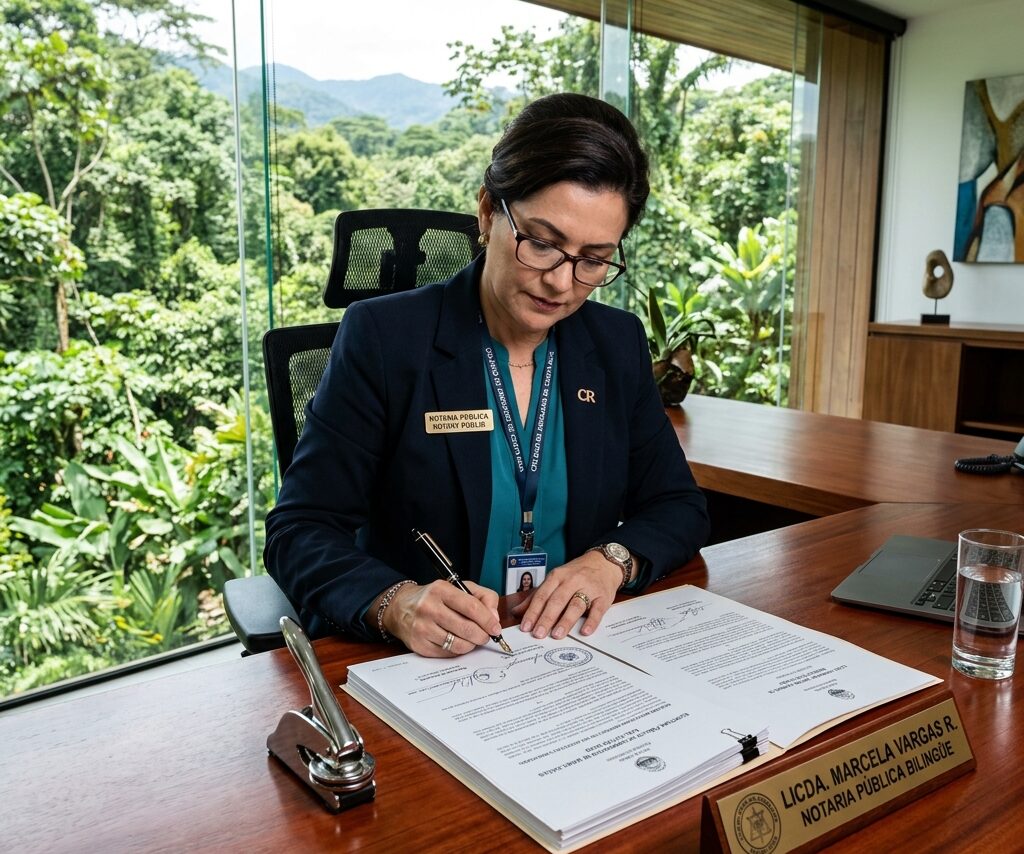

In the United States or Canada, a notary public is someone at the local bank or post office who stamps a document for $15 to verify your signature. They hold no legal liability for the content of the document.
In Costa Rica, that definition could not be further from the truth.
When you are buying property, the Costa Rican Notary Public is a specialized attorney with the power of the state. They draft the deed, they execute the closing, and they are personally liable for the legal integrity of the transaction. Hiring the wrong notary—or worse, trying to save money by using the seller’s notary—is the fastest way to commit legal suicide in this market.
If you are calculating your closing costs and looking for places to cut corners, do not cut your legal representation.
The Reality Check: In Costa Rica, all Notaries Public must be licensed attorneys, but not all attorneys are Notaries. The Notary is the only entity legally authorized to draft the transfer deed (Escritura de Traspaso) and register it in the National Registry. By law, the buyer has the absolute right to choose the Notary for the transaction, because the buyer is the one paying the Notary’s fees.
Why a Costa Rican Notary is Not What You Think
To become a Notary Public in Costa Rica, a lawyer must pass rigorous postgraduate studies and maintain an impeccable standing with the national directorate.
The Notary’s job is not just to stamp paper. Their job is to:
1. Conduct the exhaustive title search in the National Registry.
2. Verify that there are no hidden liens, municipal debts, or overlapping boundaries.
3. Draft the final transfer deed.
4. Withhold and pay the transfer taxes to the government.
5. Inscribe the new ownership in the public record.
If there is a flaw in the title that they fail to catch, they can be held financially and professionally liable.
The Golden Rule: Never Use the Seller’s Attorney
A very common tactic used by sellers (especially developers) is to say: “Just use our in-house attorney to close the deal, it will save you money.”
Never do this.
While a Notary is legally obligated to be impartial, human nature dictates otherwise. If a complex legal issue arises during due diligence, a Notary who receives a salary from the developer is not going to fiercely advocate for you, the foreign buyer.
You are paying for the legal work, which means you hold the power to choose the representation. You want a shark who works exclusively for you, digging into every single corner of the property’s history to ensure your capital is protected.
What Exactly Are You Paying For? (The 1.25% Fee Explained)
In Costa Rica, Notary fees for real estate transactions are mandated by the national bar association. The standard fee is between 1% and 1.25% of the total purchase price.
Buyers sometimes suffer sticker shock when they see a $12,500 legal fee on a $1M purchase. But you must understand that this fee covers the total liability of the transaction. It is the cost of absolute certainty. Paying 1.25% to a Notary you implicitly trust guarantees that your asset is 100% free of encumbrances before you wire the funds.
Why English Proficiency is Non-Negotiable
You are signing complex, multi-page legal documents that will dictate the future of your wealth. These documents must, by law, be executed in Spanish.
Your Notary must be flawlessly bilingual. They need to be able to explain the nuances of Costa Rican property law, maritime zone restrictions, and escrow disbursements to you in clear, plain English. If your attorney cannot translate complex legal concepts effectively, you are flying blind.
The Bottom Line
Your real estate broker finds the asset, but your Notary Public secures it. They are your ultimate shield against fraud, debt inheritance, and bad titles.
I connect my clients with the most meticulous, bilingual real estate attorneys in the country—professionals based in San Jose and Guanacaste who specialize entirely in high-net-worth foreign transactions. If you need representation you can trust, let’s talk.
📩 josh@kraincostarica.com
Frequently Asked Questions
What is the difference between a Notary in Costa Rica and the US?
In the US, a notary simply witnesses signatures. In Costa Rica, a Notary Public is a specialized, highly regulated attorney who is legally responsible for drafting property deeds, conducting title searches, and registering the transfer with the government.
Who chooses the Notary when buying a house in Costa Rica?
By custom and legal standard, the buyer has the right to choose the Notary Public because the buyer is responsible for paying the Notary’s legal fees and the associated government transfer taxes.
Are bilingual real estate attorneys common in Costa Rica?
While many attorneys speak some English, highly proficient bilingual real estate attorneys who understand the expectations of North American investors are a specialized niche. It is critical to hire representation that can clearly explain complex Costa Rican law in English.


Leave a Reply