


I had a client from Texas last month who was furious. He found a house in Tamarindo, wired a $10,000 earnest money deposit directly to the seller, and then tried to back out three weeks later because the home inspection revealed roof issues. He expected his money back. In the U.S., during a standard inspection period, that’s exactly what would happen. In Costa Rica, because his contract wasn’t structured properly with a third-party escrow, he almost lost the entire ten grand.
We see this constantly. Americans come down here, fall in love with a piece of Costa Rica real estate, and assume the transaction will mirror how things work in California or New York. It doesn’t.
Costa Rica is one of the most secure countries in Latin America for foreign investment, but you have to play by local rules. If you are looking at a Costa Rica investment property, you need to understand the mechanics of the transaction before you make an offer.
The Reality Check: Yes, Americans have the exact same property rights as Costa Ricans, and you do not need to be a resident to buy a house here. However, Costa Rica does not have a centralized MLS, and standard U.S. title companies do not exist here. Safe transactions require independent SUGEF-regulated escrow accounts, a bilingual Costa Rican Notary Public (who is actually a specialized attorney), and thorough due diligence periods built into your “Promesa de Compraventa” (purchase agreement).
The Myth of the MLS in Costa Rica
The first thing you need to know is that there is no true, legally binding MLS (Multiple Listing Service) in Costa Rica. If you go on Zillow in the States, you know exactly what a house sold for, how long it sat on the market, and the entire tax history.
Here, platforms exist that call themselves an MLS, but they are essentially fragmented listing boards. Because of this, pricing can be completely subjective, and inventory is often hidden off-market. This lack of centralized data means:
* You cannot rely on online algorithms to determine a property’s fair market value.
* You need a broker with actual “boots on the ground” who knows what properties are actually trading for, not just what they are listed for.
* You must run aggressive physical and legal due diligence, because the data isn’t handed to you on a silver platter.
The 4 Non-Negotiable Steps to Buying as a US Citizen
To execute a safe purchase, we structure every deal using four distinct steps. If a seller or an agent tries to skip any of these, walk away.
Step 1: The SUGEF Escrow Process
Never wire money directly to a seller, and never wire it to your real estate agent. You must use a third-party escrow company registered with SUGEF (Costa Rica’s financial regulatory agency). They will run strict Anti-Money Laundering (AML) checks and hold your deposit securely until the title is proven clean.
Step 2: Hiring a Notary Public (Not a US Notary)
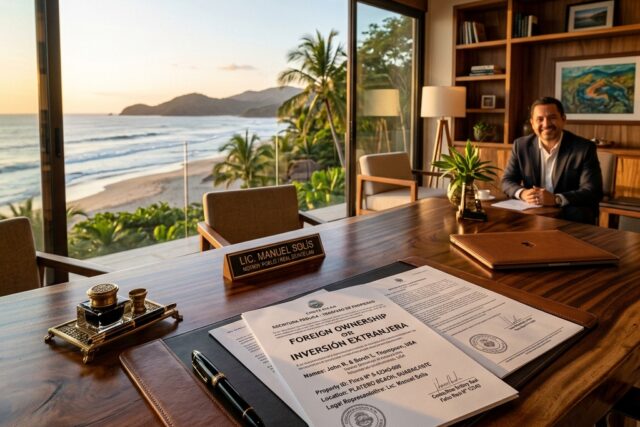
In the U.S., a notary just stamps a piece of paper. In Costa Rica, a Notary Public is a high-level attorney authorized by the government to draft and record public deeds. You must hire your own bilingual Notary—never use the seller’s attorney—to ensure your interests are protected.
Step 3: Structuring the Corporation (S.A. or LLC)
Do not buy the property in your personal name. We highly advise setting up a Costa Rican corporation (Sociedad Anónima or SRL). This isolates your liability, makes paying your annual property taxes easier, and allows you to eventually sell the shares of the corporation rather than the physical dirt, which saves thousands in closing costs later.
Step 4: Acquiring Title Insurance
While the National Registry here is highly reliable, I still mandate that my clients secure title insurance through recognized agencies like Stewart Title. It’s a minimal upfront cost that guarantees your title is completely free of hidden liens, boundary disputes, or unregistered claims.
Residency vs. Ownership: Connecting the Dots
I get asked all the time: “Do I need my residency approved before I can buy?”
The answer is no. You can buy property on a tourist visa using just your US passport. However, owning property can actually be your ticket to residency. If you invest $150,000 or more in Costa Rican real estate, you qualify for the Investor Residency program, which unlocks incredible tax benefits, including the ability to import your vehicles tax-free.
The Bottom Line
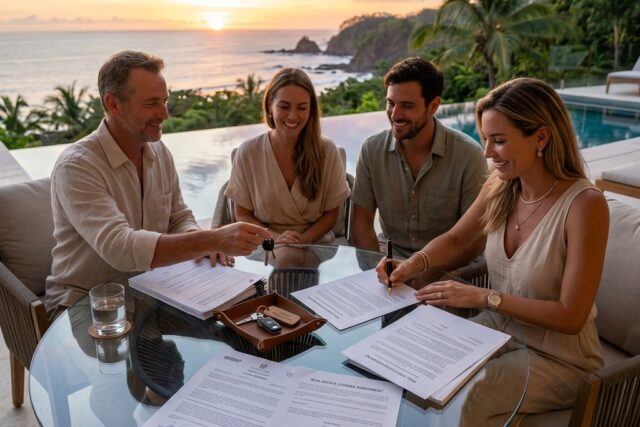
Buying property in Costa Rica as an American is incredibly secure, provided you leave your U.S. real estate assumptions at the airport. You need an airtight purchase agreement, a SUGEF-regulated escrow account, and a corporate structure that protects your asset from day one.
If you’re moving capital from the US to Guanacaste and need to structure your purchase safely, let’s talk. I’m on the ground here, and I make sure my clients’ funds are bulletproof.
📩 josh@kraincostarica.com
Frequently Asked Questions
Can US citizens buy property in Costa Rica?
Yes. U.S. citizens and other foreigners have the exact same constitutional property rights as Costa Rican citizens. You do not need to be a resident to purchase, own, or sell real estate in the country.
Do I need to be in Costa Rica to close on a property?
No. Once you have established a Power of Attorney (Poder Especial) with your chosen Costa Rican Notary Public, they can sign the closing documents on your behalf while you remain in the United States.
What are the average closing costs in Costa Rica?
Closing costs in Costa Rica typically range from 4% to 5% of the purchase price. This includes the property transfer tax (1.5%), National Registry stamps (approx. 0.85%), and the Notary Public’s legal fees (typically 1% to 1.25%).
Leave a Reply