
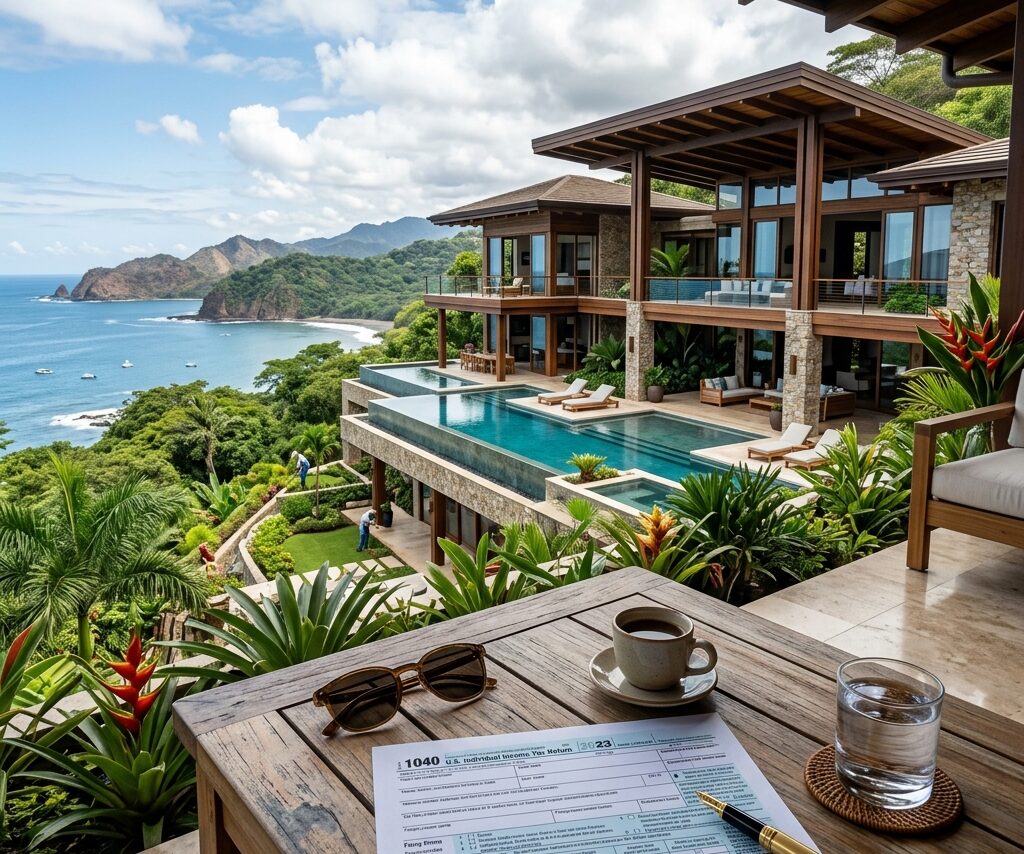

Costa Rica is famous for having incredibly low property taxes. The standard municipal property tax is just 0.25% of the registered value of the property. Compared to states like Texas, New Jersey, or California, this is a massive financial relief for high-net-worth investors.
However, if you are buying a multi-million-dollar luxury estate in Tamarindo, Santa Teresa, or Escazu, you must factor in the Impuesto Solidario—commonly referred to as the Luxury Home Tax.
This tax was implemented to fund housing programs for low-income populations. While the rates are still very reasonable compared to North American standards, failing to file or correctly calculate this tax can result in severe fines and complications when you eventually try to sell the asset.
The Reality Check: The Luxury Tax is not calculated based on the purchase price of your home. It is calculated based strictly on the construction value of the primary and secondary structures (pools, retaining walls, guest houses), plus the proportional value of the land. You must hire a certified topographer/appraiser every three years to update this valuation to remain compliant with the Ministry of Finance (Hacienda).
How the Luxury Tax is Triggered
The Luxury Tax only applies to residential properties (houses, condos, and apartments) that exceed a specific, government-defined threshold.
This threshold is adjusted annually for inflation. For the 2024–2026 period, the threshold generally sits around 148 million to 150 million Colones (approximately $280,000 to $290,000 USD, depending on the exchange rate).
Here is the critical rule:
If the construction value of your home (the physical building) is below the threshold, you do not pay the tax. The value of the land is irrelevant.
However, if the construction value is above the threshold, the tax is then calculated on the total value of the property (Construction + Land).
The Tax Brackets (2026 Estimates)
If your property crosses the threshold, it is subject to a progressive tax scale. The rates are highly manageable for ultra-high-net-worth individuals, scaling from 0.25% to 0.55% of the total value.
- Up to ~375 million Colones (approx. $735,000 USD): 0.25%
- Up to ~752 million Colones (approx. $1.47M USD): 0.30%
- Up to ~1.12 billion Colones (approx. $2.2M USD): 0.35%
- Up to ~1.5 billion Colones (approx. $2.9M USD): 0.40%
- Up to ~1.88 billion Colones (approx. $3.6M USD): 0.45%
- Up to ~2.26 billion Colones (approx. $4.4M USD): 0.50%
- Above ~2.26 billion Colones: 0.55%
Note: Exchange rates fluctuate. Always consult your Costa Rican CPA for the exact Colones-to-USD conversion during the filing period.
Compliance and The Three-Year Declaration
You cannot just guess the value of your Costa Rica investment property.
Every three years, property owners subject to this tax must file a formal declaration (Form D-179) with the Ministry of Finance. This requires hiring a certified engineer or architect to conduct a formal appraisal based strictly on the government’s manual of construction values.
The tax itself must be paid annually, usually by January 15th.
If you buy a house in Guanacaste, you inherit any unpaid luxury taxes from the previous owner. This is why conducting aggressive due diligence with a top-tier Notary Public before closing is absolutely mandatory.
The Bottom Line
Even with the addition of the Luxury Home Tax, holding costs for prime real estate in Costa Rica are dramatically lower than in the United States or Europe.
If you are running financial models on a multi-million-dollar acquisition in Costa Rica and need exact data on your projected tax liabilities, let’s talk. I will connect you with the best CPAs in the country.
📩 josh@kraincostarica.com
Frequently Asked Questions
Are property taxes high in Costa Rica?
No, they are incredibly low. The standard municipal property tax is 0.25%. Even if your home qualifies for the highest bracket of the Luxury Home Tax (0.55%), your combined maximum tax rate is only 0.80% annually.
Do condos pay the Luxury Home Tax?
Yes. The tax applies to all residential units, including single-family homes, condominiums, and apartments, provided the construction value of the specific unit exceeds the government threshold.
When is the Costa Rica Luxury Tax due?
The Impuesto Solidario (Luxury Tax) must be paid annually, with the deadline typically falling on January 15th. The formal valuation declaration (Form D-179) must be filed every three years.

Leave a Reply