
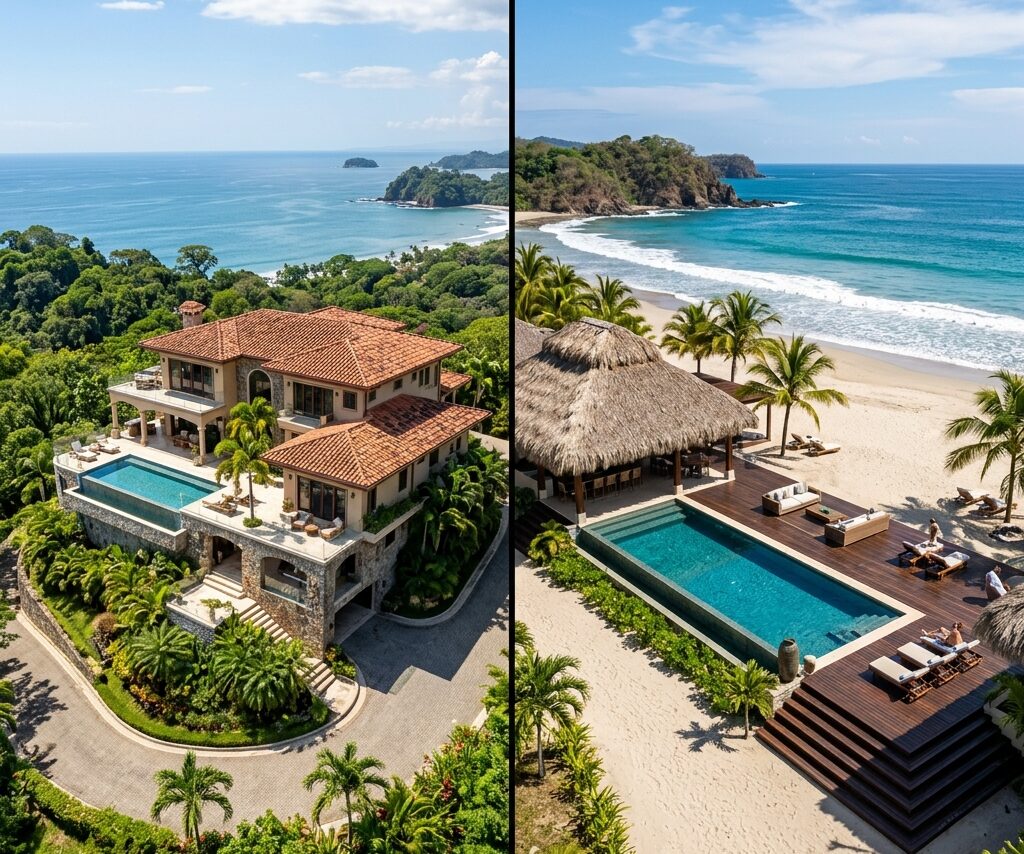

I get calls every week from buyers wanting a luxury villa right on the sand in Guanacaste. They have cash ready and tell me, “I want full ownership, right on the water, no compromises.”
I always have to pause and give them a reality check about Costa Rican geography. If you are looking for beachfront villas and expect to own the dirt beneath the house exactly the way you would in Malibu or Miami, you are hunting for a unicorn. In Costa Rica, 95% of all beachfront property is not owned outright—it is leased from the government.
Buying a concession property is not inherently bad, but treating it like a standard “fee-simple” asset will cost you dearly. If you are looking at Guanacaste property, you must understand the Maritime zone laws before you write a deposit check.
The Reality Check: In Costa Rica, the Maritime Zone Law dictates that the first 200 meters of land measured from the high-tide mark belong to the state. The first 50 meters are strictly public domain where nothing can be built. The next 150 meters form the “Restricted Zone,” which can be leased via a government “Concession” (usually for 20 years). Only about 5% of all beachfront property in the country is “Fee-Simple,” meaning it holds a fully titled deed up to the 50-meter mark.
The 200-Meter Rule You Must Understand
To understand beachfront real estate here, you have to understand the math of the coastline. The government protects the beaches heavily, which is great for the environment but complex for investors.
If you are looking at properties in places like Playa Grande or the south end of Tamarindo, you are dealing with the Maritime Terrestrial Zone (ZMT). It is divided into two distinct strips:
* The Public Zone (First 50 meters): Measured from the median high-tide line. This is completely public. No one can own it, and absolutely no permanent structures can be built on it. Period.
* The Restricted Zone (Next 150 meters): This is where you can build homes or hotels, but you do not “own” the land. You apply for a concession from the local municipality.
Concession Land: How It Works and Who Can Own It
A concession is essentially a long-term lease from the government, typically granted for 20-year periods. As long as you pay your annual canon (concession fee) and abide by the zoning laws, the lease is indefinitely renewable.
However, there is a catch for foreigners: A non-resident foreigner cannot hold more than 49% of a concession in their personal name.
* To legally hold a concession as a foreigner, you must either have resided in Costa Rica for over five years, or you must hold the property in a Costa Rican corporation (S.A.) where 51% of the shares are controlled by a Costa Rican citizen or a wholly-owned Costa Rican entity.
* This requires aggressive legal structuring—usually involving a trust—to ensure your investment is protected while satisfying the 51% local ownership rule.
Fee-Simple: The Rare 5% of Beachfront Real Estate
Now, what about that other 5%? “Fee-simple” (Titled) beachfront property means the land was registered and titled before the 1977 Maritime Zone Law went into effect. Places like Flamingo, Langosta, and parts of Tamarindo have pockets of true fee-simple beachfront.
With fee-simple property:
* You own the land outright, up to the 50-meter public zone.
* Foreigners can own 100% of the property in their own name or through an LLC with zero restrictions.
* Because this type of inventory is incredibly scarce, it commands a massive premium on the open market.
How Maritime Laws Impact Your Exit Strategy
When I advise clients on beachfront investments, we always look at the exit strategy.
Because fee-simple properties are rare and unrestricted, they are highly liquid and easy to resell to foreign buyers. Concession properties, on the other hand, trade at a discount compared to fee-simple. They offer incredible locations—often directly on the sand—but they require a more sophisticated buyer. Furthermore, U.S. banks will not lend against a Costa Rican concession, so you are dealing exclusively in cash markets or seller-financing scenarios.
The Bottom Line
You can make an incredible return on both fee-simple and concession properties, provided you know exactly what you are buying. Don’t let fear keep you away from a concession, but don’t let ignorance lead you to overpay for one, either.
If you’re evaluating beachfront property and need someone who actually understands maritime zoning laws and how to structure the purchase legally, let’s talk.
📩 josh@kraincostarica.com
Frequently Asked Questions
What is the difference between fee-simple and concession in Costa Rica?
Fee-simple property holds a clear title that you own outright indefinitely. A concession is a long-term lease (usually 20 years, renewable) on government-owned land within the 150-meter Restricted Zone along the coast.
Can an American citizen own a beachfront concession in Costa Rica?
Yes, but with restrictions. A foreigner without five years of residency cannot hold more than 49% of a concession personally. You must use specific legal structures, such as a Costa Rican corporation combined with a trust, to comply with the 51% local ownership requirement while protecting your capital.
Is it safe to buy concession property in Costa Rica?
Yes, provided the concession is officially approved, registered in the National Registry, and the zoning (Plan Regulador) allows for your intended use. However, aggressive legal due diligence is mandatory to ensure there are no infractions that could threaten the renewal of the lease.

Leave a Reply